Origin Flight 1
First ever launch to kick off the StarSeek project. Tiny class-A motor, cardboard body, plastic nose cone and fins. No avionics apart from a tiny commercial altimeter. Simple parachute recovery. Getting off the launchpad would be a success, let alone hitting the 47m target apogee.
- Apogee(est.)
- 47.0 m
Footage
Flight data
The flight computer didn't record this flight, so these figures are estimates.
- Apogee(est.)
- 47.0 m
Rocket & motors

StarSeek-Origin
- Height
- 482 mm
- Diameter
- 25 mm
- Weight
- 63 g
- Total impulse
- 2.5 N·s
- Target apogee
- 47 m
- Recovery
- Single-deploy Parachute
Motor configuration
- Klima A6-4KlimaClass A · 18 mm · 2.5 N·s
Simulation predictions
Before flight, the rocket was simulated across 8 weather scenarios.
- Target apogee
- 47 m
- Expected apogee
- 45–49 m
- Max wind — nominal
- 15 m/s
- Max wind — turbulence
- 8 m/s
Retrospective
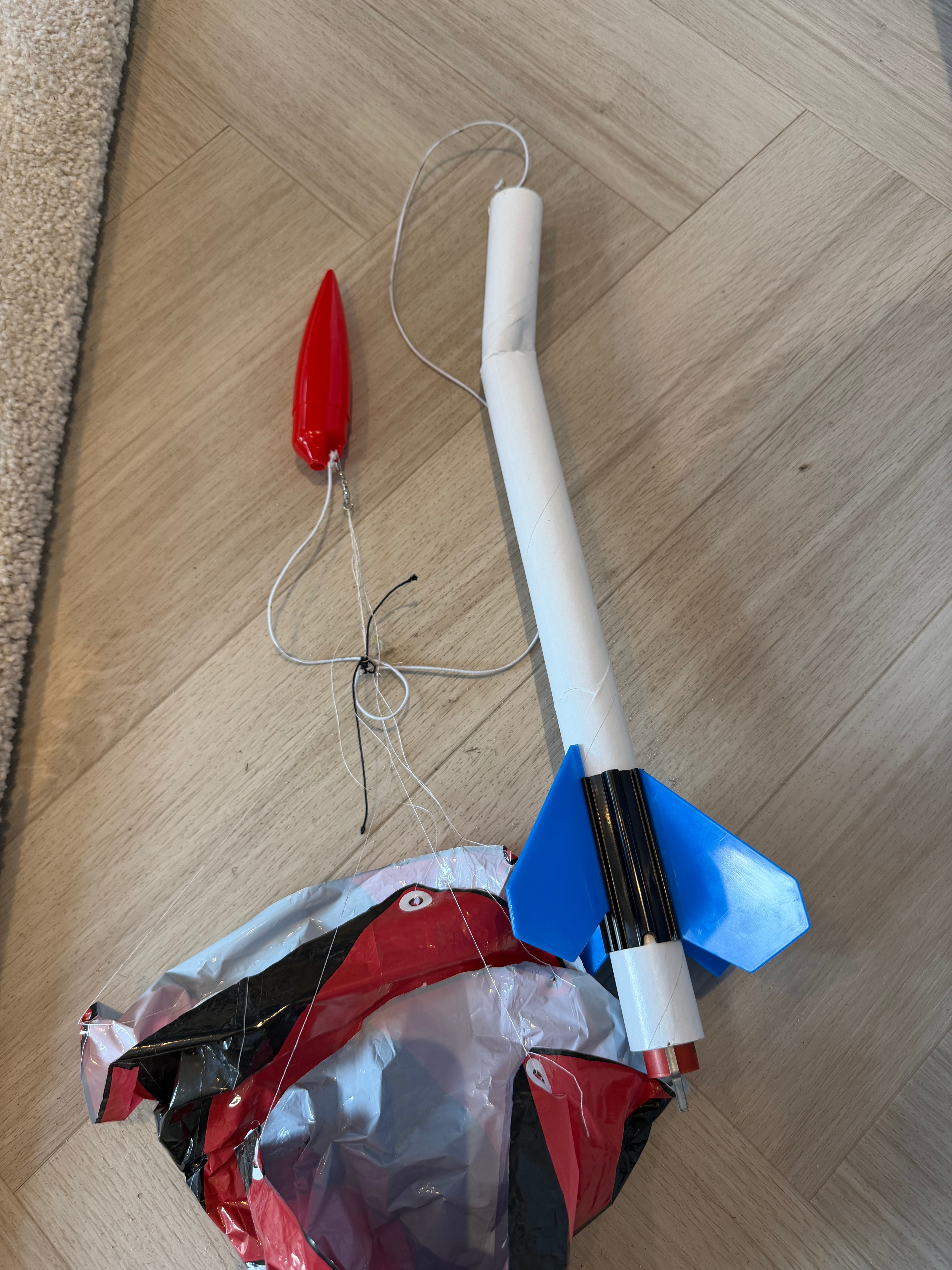
Ignited first time and launched well, reaching an altitude of approximately 46m. An avionics failure meant we didn't capture any telemetry and too much wadding prevented the parachute from deploying - resulting in a crash landing, dashing any hopes of re-using the rocket for future flights. Overall success, but lots of lessons learnt for the next launches!
Lessons learned
- The Nano V1 altimeter appears to randomly reset to factory defaults, which are set with a minimum launch detection force that's too high to detect the low G pulled by class A take-offs. This resulted in the flight not being detected by the altimeter and no data being recorded.
- Too much wadding stopped parachute ejection.
- Lack of payload bay left avionics tangled in the parachute shroud lines and covered in black powder, we're lucky it survived at all - albeit without data.
- Plastic parachute stuck together in the heat (ambient temp was 35 degrees). Even if it had left the rocket body it's unlikely it'd have fully unfolded and deployed correctly.
- Launch pad only had the ability to level on one axis, so getting a perfectly vertical launch angle wasn't possible
- Difficult to get good video of entire launch. Used a mobile phone to film the launch, we'll need a much better system going forward. We should consider multiple cameras to get close up footage of the launch (potentially in slow motion which could aid future diagnostics) as well as full-flight footage.
- Launch control wires are far too short, both from a safety perspective as we start to look at larger motors but also don't allow us to reach the protected seating area for launches which means the ground station kit all has to sit on the ground.
- We need a better way to get real-time information on wind speed and direction at the launch site.